Why Gamified Habit Apps Work (and When They Stop Working)

Points for a completed habit. A level-up animation. An avatar that grows stronger the more consistent you are. Gamified habit apps use these mechanics deliberately, and it's easy to dismiss them as a gimmick layered on top of a to-do list. But the psychology behind it is real — the question worth asking isn't whether gamification works, it's how long it works, and what happens when it stops.
The short answer
Gamification works because points, streaks, and levels tap directly into the brain's reward and achievement systems — visible progress and small wins are genuinely motivating, especially early on. The risk is that this kind of motivation is largely extrinsic: it comes from an external reward (points, a badge) rather than from a reason you actually care about. Extrinsic motivation is powerful short-term and tends to fade once the novelty wears off, which is why gamification works best paired with genuine intrinsic motivation — a reason the habit matters to you — rather than used as a substitute for one.
The psychology behind why it works
A few real mechanisms are at play:
Immediate feedback. Completing a habit and seeing a number go up, a bar fill, or an animation play gives your brain an instant, visible signal of progress. Real-life habit change is usually slow and hard to see day to day — gamification manufactures a feeling of progress that the underlying behavior change doesn't naturally provide on its own timeline.
Loss aversion. Some gamified systems let you lose points, health, or status for skipping a habit, which adds a small stake to not breaking the pattern. People are generally more motivated to avoid a loss than to pursue an equivalent gain, so this framing can genuinely increase follow-through.
Streaks as a visible chain. Even outside full gamification, a simple streak counter uses the same underlying mechanism — see how habit streaks work for more on why a number that climbs is more motivating than an abstract sense of "doing better."
Achievement and mastery. Levels, badges, and unlocks tap into a basic human drive to get better at something and have that improvement recognized, even by a system as simple as an app.
Why it stops working
The same mechanics that make gamification effective early tend to lose power over time, for a few predictable reasons:
- Novelty fades. The first time you level up feels exciting. The fortieth time is just routine, and the reward stops carrying the same weight.
- Extrinsic motivation crowds out intrinsic motivation. If you start doing a habit "for the points," you can end up focused on the game layer rather than on why you wanted the habit in the first place — and when the points stop feeling exciting, the habit can stop too, because the actual reason for it never got reinforced.
- The system itself becomes a chore. Managing an avatar, gear, or a party adds real overhead, and for some people that overhead eventually outweighs the motivational benefit. This is a common reason people look for Habitica alternatives after a few months.
Replacify helps you swap a bad habit for a better one — with structured paths, an SOS button for cravings, a focus timer, and streaks that keep you going.


How to make gamification actually last
The fix isn't to avoid gamification — it's to pair it with something that doesn't fade: a genuine reason the habit matters to you. This is where identity-based habits becomes relevant — instead of "I get points for running," the more durable frame is "I'm becoming someone who runs," which keeps working even after the points stop feeling novel. Gamification can still help — it's a good on-ramp and a nice source of short-term feedback — but it works best as reinforcement for a reason you already have, not as the reason itself.
Concretely, that looks like: pick a habit connected to an actual value or identity you care about, use gamified feedback (streaks, badges, milestones) as a bonus layer on top, and don't rely on the game mechanics alone to carry you once the novelty wears off around week three or four — which is a very common point where gamified apps quietly lose users.
The bottom line
Gamification isn't a trick — it uses real psychological mechanisms, and it can genuinely help you get started and stay consistent early on. The catch is that it's mostly extrinsic motivation, which tends to fade once the novelty wears off. The habits that actually last are usually the ones where gamified feedback reinforces a reason you already care about, not the ones where the points are the entire reason.
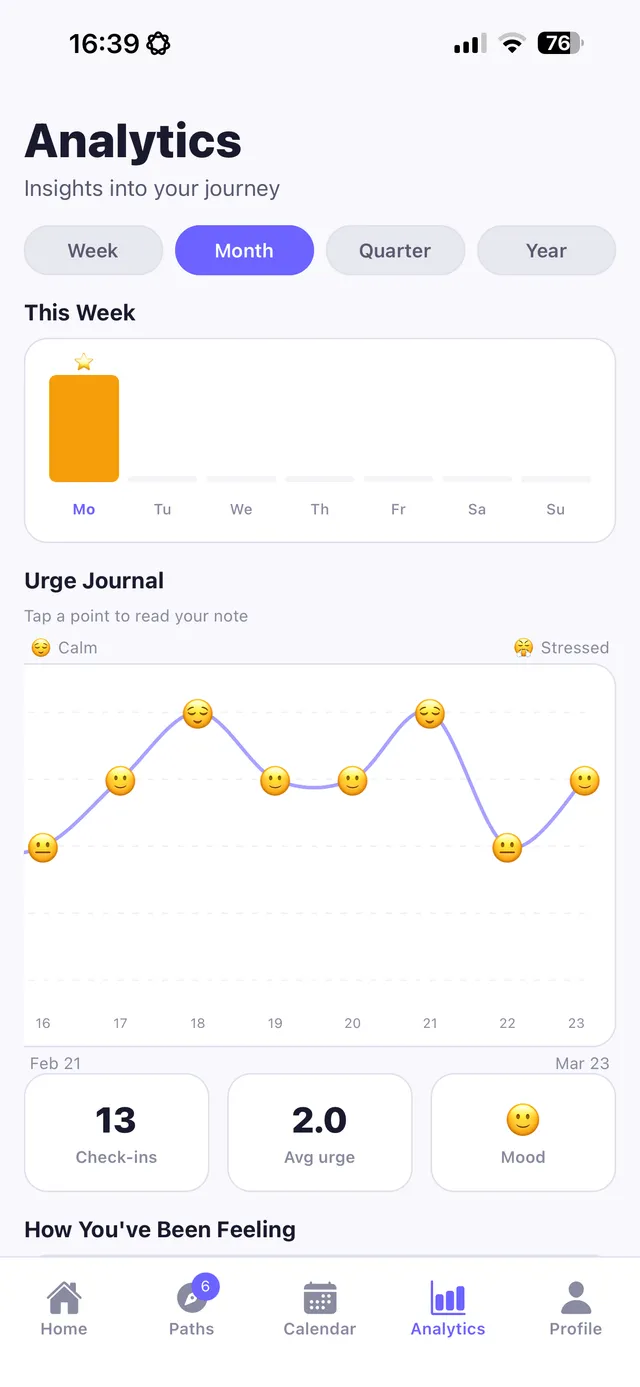
Replacify uses light gamification — streaks, badges, visible progress — but builds it around a replacement path chosen for your specific struggle and a free SOS tool for the moment an urge hits, so the motivation doesn't depend on points alone once the novelty wears off.
Frequently asked questions
Why do gamified habit apps work?
They tap into real psychological mechanisms — immediate feedback from points or levels, loss aversion when you risk losing progress, and a basic drive toward achievement and mastery. These make progress feel visible and rewarding, especially early on.
Why do people stop using gamified habit apps over time?
The novelty of points and levels tends to fade, and gamification is largely extrinsic motivation — it can crowd out the actual reason you wanted the habit in the first place. Once the game stops feeling exciting, motivation can drop off with it.
Is gamification bad for building habits?
No, but it works best as a bonus layer rather than the whole strategy. Pairing gamified feedback with a genuine, identity-level reason for the habit tends to produce more lasting change than gamification alone.
Does Replacify use gamification?
Yes, in a light form — streaks, badges, and visible progress — but it's built around a chosen replacement path and a free SOS urge tool, so motivation isn't dependent on the game layer alone once the novelty fades.
Replace the habit. Not yourself.
Replacify helps you swap a bad habit for a better one — with structured paths, an SOS button for cravings, a focus timer, and streaks that keep you going.