The Two-Minute Rule: How to Start Any Habit Without Relying on Willpower

The single biggest reason new habits fail isn't lack of motivation — it's that the first step feels too big. "Read more" feels like a chore. "Read one page" doesn't. The two-minute rule, popularized by James Clear in Atomic Habits, is a deceptively simple fix: scale any habit down until it takes two minutes or less to start.
The short answer
The two-minute rule says: when starting a new habit, it should take less than two minutes to do. "Run three miles" becomes "put on my running shoes." "Read 30 pages" becomes "read one page." The rule isn't about the two minutes being the whole habit forever — it's about making the starting point so easy you can't talk yourself out of it. Once you're in motion, continuing is far easier than starting was.
Why it works: activation energy
Every habit has a moment of resistance right before it starts — the point where you decide whether to begin or to scroll five more minutes instead. Behavioral scientists sometimes call this the activation energy of a behavior: the effort required to get moving, distinct from the effort required to sustain it. A five-mile run and putting on running shoes require wildly different activation energy, even though the shoes are what actually gets you out the door.
The two-minute rule works by targeting activation energy, not the whole habit. It doesn't ask you to become a different person overnight — it asks you to master the first two minutes of showing up. Once your brain associates the cue with an easy, low-stakes action, you build consistency. Consistency is what eventually lets you extend the habit.
This connects directly to Law 3 of the 4 Laws of Behavior Change — "make it easy." The two-minute rule is the most concrete, practical version of that law.
It's a gateway, not the ceiling
A common misreading of the rule is thinking two minutes is the goal forever. It's not — it's a landing pad. "Read one page" is designed to often turn into ten pages once you're sitting there with the book open. The rule protects you from the days you genuinely only do two minutes (which still counts, still keeps the streak alive, still reinforces the identity) while leaving room for the days you do more.
This matters most on your hardest days — tired, busy, unmotivated. On those days, the two-minute version is still achievable, and "doing something, however small" protects your habit streak and your identity as someone who shows up. See how habit streaks work for why consistency beats intensity.
Two-minute versions: real examples
| Full habit | Two-minute starting version |
|---|---|
| Go for a 30-minute run | Put on running shoes and step outside |
| Read 30 pages | Read one page |
| Meditate for 20 minutes | Sit down and take 5 breaths |
| Write a chapter | Open the document and write one sentence |
| Do a full workout | Do one set, or unroll the yoga mat |
| Cook a healthy dinner | Chop one vegetable |
| Clean the whole apartment | Clear one surface |
| Practice guitar for an hour | Pick up the guitar and play one chord |
| Journal a full page | Write one line about your day |
| Learn a language | Do one flashcard |
Notice the pattern: each two-minute version removes the decision-making and the friction, and leaves only the physical act of starting.
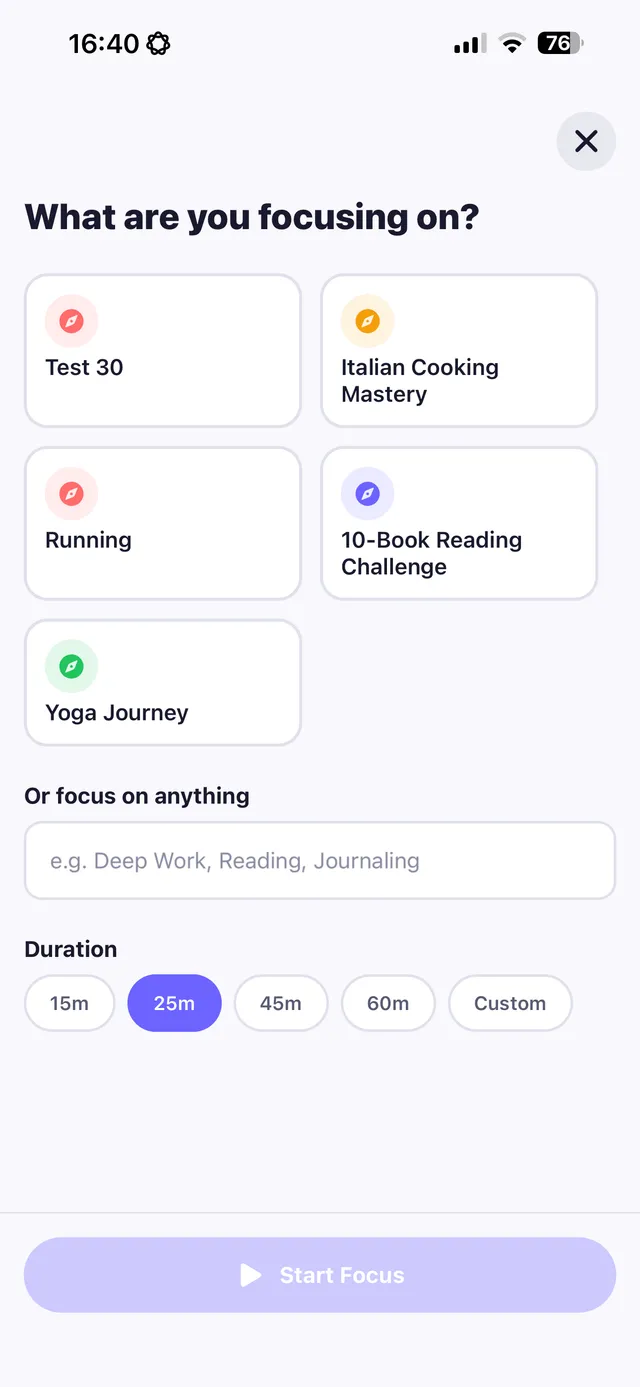
Replacify helps you swap a bad habit for a better one — with structured paths, an SOS button for cravings, a focus timer, and streaks that keep you going.


Using it to replace a habit, not just build one
The two-minute rule is just as useful when you're trying to quit or replace something. If a craving hits, the alternative you reach for needs its own low-activation-energy version — a two-minute breathing exercise, a two-minute walk, a two-minute stretch — because in the moment of an urge, you won't have the willpower to start something that feels like effort. This is exactly the logic behind what to do when a craving hits: the replacement has to be easier to start than the habit you're trying to avoid, or you'll default to the old one.
It also pairs naturally with habit stacking — "after I sit down at my desk, I will write one sentence" gives the two-minute version both a cue and a low-friction first step.
The bottom line
The two-minute rule works because it targets the actual point of failure — the moment before you start, not your commitment once you've begun. Scale any habit down until the first step is almost embarrassingly easy, and you remove the excuse that stops most people before day three. Replacify builds this into its replacement paths: instead of "quit vaping" or "stop doom-scrolling," you get a specific, small action to reach for — and the free SOS button gives you a two-minute activity the instant an urge hits, so starting never depends on willpower you may not have that day.
Frequently asked questions
What is the two-minute rule?
A rule from James Clear's Atomic Habits that says any new habit should be scaled down to something that takes less than two minutes to start, like 'read one page' instead of 'read 30 pages.'
Does the habit have to stay at two minutes forever?
No. The two minutes is a starting point designed to lower the barrier to beginning. Many days it naturally extends into more; on hard days, doing just the two-minute version still keeps the habit and your streak alive.
Why does the two-minute rule work?
It targets activation energy — the resistance you feel right before starting a habit — rather than the full effort of the habit itself. A small, easy first step is much harder to talk yourself out of.
Can the two-minute rule help with cravings, not just new habits?
Yes. Having a two-minute replacement action ready — a short walk, a breathing exercise — gives you something easy to reach for the moment an urge hits, which is more realistic than expecting willpower alone to work.
Replace the habit. Not yourself.
Replacify helps you swap a bad habit for a better one — with structured paths, an SOS button for cravings, a focus timer, and streaks that keep you going.