Why You Do a Habit at Home but Not on Vacation: Context and Cues

You go on vacation and suddenly you're not biting your nails, not snacking at 9pm, not reaching for your phone every ten minutes — and you didn't even try. Then you get home and within a day or two, you're right back to normal. Or the opposite happens: the gym habit you'd built over months quietly disappears the moment your schedule or your apartment changes. This isn't a willpower story. It's a context story, and understanding it changes how you build and break habits.
The short answer
Habits aren't stored as pure behaviors — they're stored as behavior-plus-context. The specific location, time, routine, or even the exact chair or device you use becomes part of the trigger. That's why moving, traveling, or changing your schedule disrupts habits (both the ones you want to keep and the ones you're trying to quit), and why deliberately choosing a context — a specific reading chair, a specific gym time slot — is one of the most reliable ways to build a new habit fast.
Why context is baked into the cue
When a habit forms, your brain isn't just learning "when I feel X, I do Y." It's learning a much more specific version: "when I'm in this place, at this time, doing this sequence of things, I do Y." The location, the lighting, the sounds, the objects around you — all of it becomes part of the trigger, even though you never consciously chose most of it.
This is part of the habit loop: the cue that kicks off a behavior is rarely just one clean signal. It's usually a bundle of contextual details your brain has quietly learned to associate with the behavior. Strip enough of those details away — by traveling, moving apartments, changing jobs, or even rearranging furniture — and the cue stops firing reliably.
Why vacation breaks bad habits (temporarily)
This explains a pattern almost everyone has noticed: bad habits often fade on vacation without any deliberate effort. You're not sitting at the same desk, you don't have the same evening routine, you're not surrounded by the same objects. The contextual cues that normally trigger the habit simply aren't present, so the automatic behavior doesn't fire.
The catch is that this relief is temporary. As soon as you're back in the original context — same desk, same chair, same evening routine — the old cues come right back online, often within a day or two. This is one reason quitting something "cold turkey" during a trip can feel deceptively easy and then collapse the moment you're home; see cold turkey vs. cutting down for more on why context-blind quit strategies often don't hold.
Why moving disrupts good habits too
The same mechanism works against you when you're trying to protect a good habit. A consistent gym routine that took months to feel automatic can unravel within weeks of a move, a new job, or even a change to your commute — not because your motivation dropped, but because the contextual cues that used to trigger "go to the gym" (the route past it, the time slot, the gym bag by the door) no longer exist in the new environment.
This is why "just keep doing it" advice often fails after a disruption. The habit didn't get weaker — its cue got deleted.
Replacify helps you swap a bad habit for a better one — with structured paths, an SOS button for cravings, a focus timer, and streaks that keep you going.


Using context on purpose
Once you know context is doing this much work, you can recruit it deliberately instead of leaving it to chance.
| Technique | Example |
|---|---|
| Dedicate a specific spot | A "reading chair" used for nothing else builds the reading-cue fast |
| Fix the time slot | Same gym window every day builds a stronger cue than "whenever I have time" |
| Use a distinct object | A journal kept only by your bed cues nighttime reflection |
| Change your context to break a habit | Working from a different room, or rearranging your desk, weakens an old phone-scrolling cue |
| Rebuild context after a move | Recreate the cue deliberately — same relative desk position, same morning sequence — instead of assuming the habit will transfer automatically |
This is also why environment design and habit stacking work so well together — stacking borrows an already-strong contextual cue from an existing routine, and environment design makes sure the physical context supports the behavior you actually want.
The bottom line
Habits live in context as much as they live in you. A change of scenery can quiet a bad habit for a while and just as easily unravel a good one — not because your discipline changed, but because the cues did. The fix isn't more willpower; it's designing the context on purpose: a fixed spot, a fixed time, a fixed trigger you control.
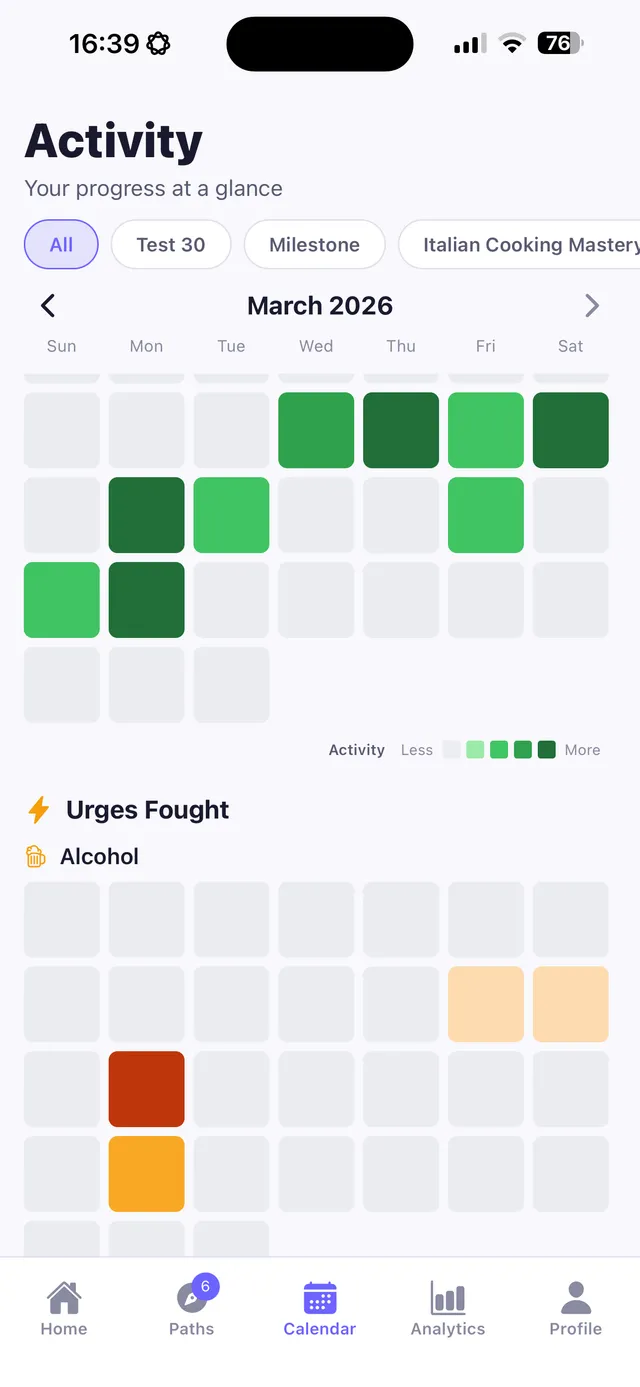
Replacify leans into this directly. When you pick a struggle and a replacement path, you're choosing a specific new behavior to attach to the moments and contexts where the old habit used to fire. If a new environment — travel, a new routine, a stressful week — throws off your cues anyway, the SOS button gives you something to do in that exact moment, and your streak calendar shows you whether the new context is actually sticking.
Frequently asked questions
Why do I stop a bad habit on vacation without trying?
Habits are tied to context — location, routine, objects around you — not just the behavior itself. Vacation removes the usual contextual cues, so the automatic trigger doesn't fire, though it typically returns once you're back in the original environment.
Why did my good habit disappear after I moved or changed jobs?
The habit was likely attached to specific contextual cues — a route, a time slot, a physical space — that no longer exist in your new environment. The habit didn't weaken on its own; its trigger was removed.
Can I use context to build a habit faster?
Yes. Dedicating a specific, consistent place, time, or object to a new behavior — like a chair used only for reading — helps your brain form a strong, reliable cue much faster than a floating, inconsistent routine.
Does rearranging my space actually help break a bad habit?
It can. Since context is part of the trigger, changing your physical environment — a different room, a rearranged desk, removing an object — can weaken the automatic cue that normally sets off the habit.
Replace the habit. Not yourself.
Replacify helps you swap a bad habit for a better one — with structured paths, an SOS button for cravings, a focus timer, and streaks that keep you going.