Habit Tracking vs Goal Setting: Why Systems Beat Goals

"Run a marathon." "Read 50 books this year." "Quit vaping by summer." Goals like these feel motivating for about a week, and then the motivation crashes — either because you hit the goal and don't know what to aim for next, or because you fell behind and the whole thing feels pointless. That crash isn't a personal failing. It's what happens when a goal has no system underneath it.
The short answer
A goal is an outcome — a specific result you want at some point in the future. A system (or habit) is the repeated action you take regularly that produces that outcome as a side effect. Goal-only thinking causes motivation crashes because goals only pay off once, at the finish line, while systems pay off every time you complete them. The fix isn't to abandon goals — it's to translate every goal into a specific, trackable daily or weekly action, and then track that, not the distant outcome.
Why goals alone don't hold up
Goals have a structural problem: they're binary and far away. You either hit "run a marathon" or you don't, and that verdict only arrives once, months from now. In between, a goal gives you almost nothing to act on day to day — it tells you the destination, not the next step.
This creates two common failure modes:
- The goal is achieved, and motivation disappears with it. People who set a goal like "lose 20 pounds" often regain the weight after hitting the number, because the goal — not the underlying system — was the thing driving behavior. Once it's achieved, there's no target left to pull them forward.
- The goal is missed, and it feels like total failure. If you're behind on "read 50 books" by October, the whole goal can start to feel pointless, even if you've built a genuinely strong reading habit along the way. The all-or-nothing framing erases real progress.
Why systems hold up better
A system doesn't have this all-or-nothing problem, because it isn't measured by a distant finish line — it's measured by whether you did the action today or this week. "Read for 15 minutes most days" pays off constantly: every session is a win you can actually feel, not a fraction of a far-off outcome.
This connects directly to identity-based habits: a system built around "I'm someone who reads daily" keeps generating reward and motivation long after any specific book-count goal would have stopped mattering, because the system itself — not a number — is the thing being reinforced.
Translating a goal into a system
Most goals can be broken into a trackable action in a few steps:
| Goal | System (the trackable action) |
|---|---|
| Run a marathon | Run 3x/week, following a training plan |
| Read 50 books this year | Read for 15–20 minutes daily |
| Quit vaping | Log a craving and its replacement action each time one hits |
| Save $10,000 | Automatically transfer a fixed amount weekly |
| Write a book | Write 300 words most days |
| Get fit | Do a short workout 4x/week |
Notice the system column is always something you can do today, regardless of how far the outcome still is. That's the entire point — a system gives you a next action, a goal only gives you a destination.
Replacify helps you swap a bad habit for a better one — with structured paths, an SOS button for cravings, a focus timer, and streaks that keep you going.


Track the system, not the outcome
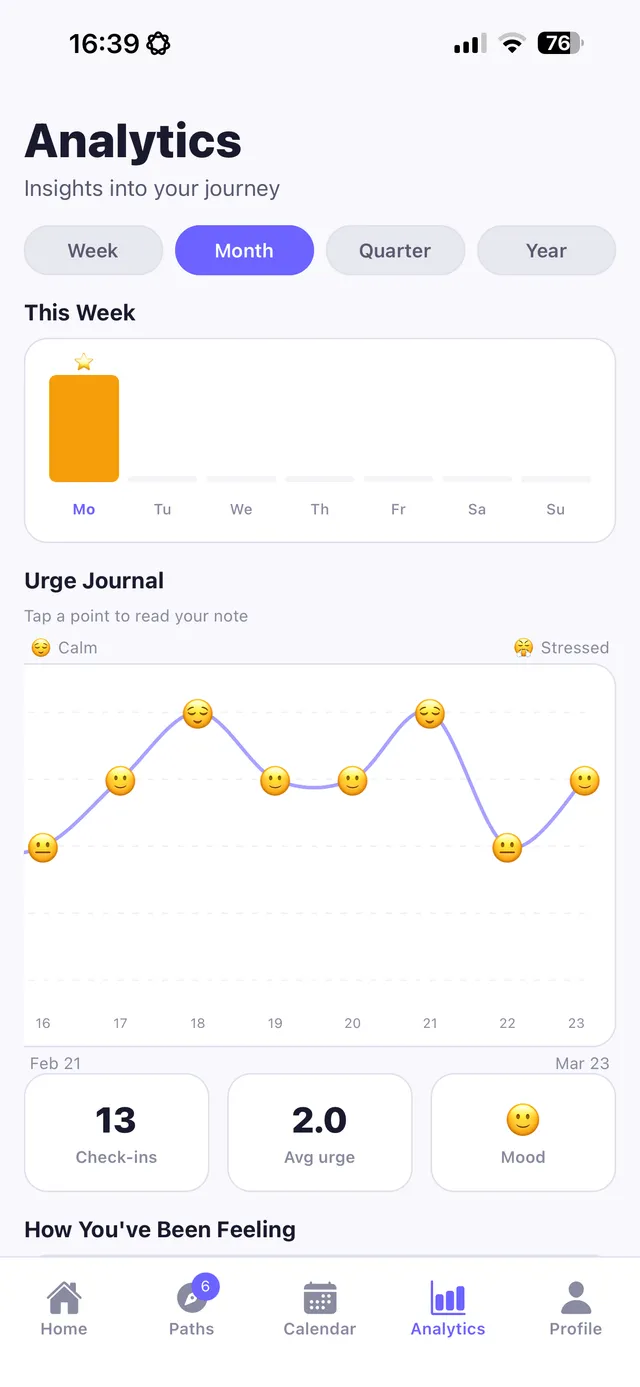
Once a goal is translated into a system, the tracking should follow the system, not the original number. Tracking "did I do the action today" is more motivating and more accurate than tracking progress toward a distant total, for a simple reason: it's immediate, and immediate feedback is what actually reinforces a habit loop (see how habit streaks work for more on why streak-based tracking works so well).
This also makes setbacks less catastrophic. Missing a day of the system is a small, recoverable event. Falling behind on a distant numeric goal can feel like the whole thing is unsalvageable, even when it isn't — which is exactly the trap that thinking in systems instead of goals is designed to avoid.
The bottom line
Goals are useful for deciding direction, but they're a poor daily motivator because they only resolve once, far in the future. Systems — the repeated actions that produce the outcome — are what you can actually track, feel progress on, and stay motivated by, day after day. The move isn't to drop goals; it's to translate every goal into a specific action you can do today, and track that instead.
Replacify is built around systems, not distant outcomes. Instead of asking you to hit a number, it asks you to choose a struggle and a replacement path, then tracks whether you showed up for that system — day by day, streak by streak — with the SOS button ready for the moments the system gets tested by a craving or urge.
Frequently asked questions
What's the difference between a goal and a system?
A goal is a specific outcome you want at some point in the future, like running a marathon. A system is the repeated action you take regularly — like running three times a week — that produces that outcome as a byproduct.
Why do goals often lead to motivation crashes?
Goals only resolve once, either when achieved or missed, which removes the target that was driving behavior either way. A system keeps paying off every time you complete it, so motivation doesn't depend on a single distant finish line.
How do I turn a goal into a trackable system?
Identify the repeated action that would produce the outcome — for example, 'read 15 minutes daily' instead of 'read 50 books' — and track whether you did that action, rather than tracking progress toward the distant number.
Is habit tracking better than goal tracking?
For daily motivation, generally yes. Tracking whether you completed a small, repeatable action gives immediate feedback that reinforces the habit loop, while tracking a distant numeric goal often feels demotivating until the very end.
Replace the habit. Not yourself.
Replacify helps you swap a bad habit for a better one — with structured paths, an SOS button for cravings, a focus timer, and streaks that keep you going.