Variable Rewards: The Psychology Trick Behind Your Most Addictive Habits

Why is it so much harder to put your phone down than to stop reading a book at a boring page? Both offer a reward. But one delivers it on a predictable schedule and the other doesn't — and that difference turns out to be one of the most powerful forces in behavioral psychology. It's called variable reinforcement, and it's the mechanism behind slot machines, notifications, infinite-scroll feeds, and quite a few of your own toughest habits.
The short answer
Variable (or intermittent) reinforcement means a reward arrives unpredictably rather than every single time. Research going back decades in behavioral psychology consistently finds that unpredictable rewards produce stronger, more persistent, harder-to-quit behavior than rewards delivered on a fixed, predictable schedule. This is a large part of why checking your phone feels so compulsive — you don't know if this check will have something good, and that uncertainty is precisely what keeps you checking. The flip side is useful too: you can apply the same principle deliberately, with predictable rewards, to make good habits stick.
Why unpredictability is more compelling than certainty
This might seem backwards at first — wouldn't a guaranteed reward be more motivating than a maybe? In practice, the opposite tends to be true for maintaining a repeated behavior. When a reward is guaranteed every time, the anticipation flattens out; you know what's coming, so there's less of a pull to check "just in case." When a reward is uncertain, each instance of the behavior carries a small chance of a payoff, which keeps your brain's reward-anticipation system engaged in a way certainty doesn't. This general pattern — unpredictable reinforcement sustaining behavior more powerfully than predictable reinforcement — is one of the more robust findings to come out of behavioral psychology, and it maps closely onto ideas about dopamine and reward prediction, not just reward delivery. Your brain responds strongly to the uncertainty itself, not only to the reward.
Where you already experience this
Once you know the pattern, it shows up everywhere:
| Behavior | The variable reward |
|---|---|
| Checking your phone | Sometimes a message, like, or interesting post; often nothing |
| Refreshing social feeds | The next scroll might be boring or might be great — you don't know until you look |
| Slot machines and gambling | Wins arrive unpredictably, keeping play going far longer than a guaranteed payout would |
| Checking email | Most is routine; occasionally something exciting or urgent |
| Random compliments or attention | Unpredictable positive feedback from others can be more reinforcing than routine praise |
None of these are accidents. Products built around attention — especially social apps and games — are frequently designed around variable reward schedules precisely because they're so effective at sustaining engagement. That's a big part of the mechanism behind phone addiction signs and what people mean when they talk about brain rot from constant unpredictable-reward scrolling.
Using variable rewards against yourself, or for yourself
You can't easily uninstall the mechanism, but you can work with it in both directions.
To weaken a habit's pull: make the reward more predictable, or remove it. Turning off notifications, for example, removes the intermittent "maybe something's there" pull that keeps pulling you back to your phone. A dopamine detox isn't magic — but temporarily reducing exposure to variable-reward triggers does lower how often that uncertainty gets reactivated.
To strengthen a new habit: don't rely purely on variable rewards, since they're hard to engineer deliberately for yourself. Instead, pair a new habit with a small, predictable reward at first, so the behavior gets reinforced consistently while it's still fragile. Occasional bonus rewards — a bigger treat after a full week, an unexpected mark of progress — can then layer some of that variable-reward pull on top once the base habit is established.
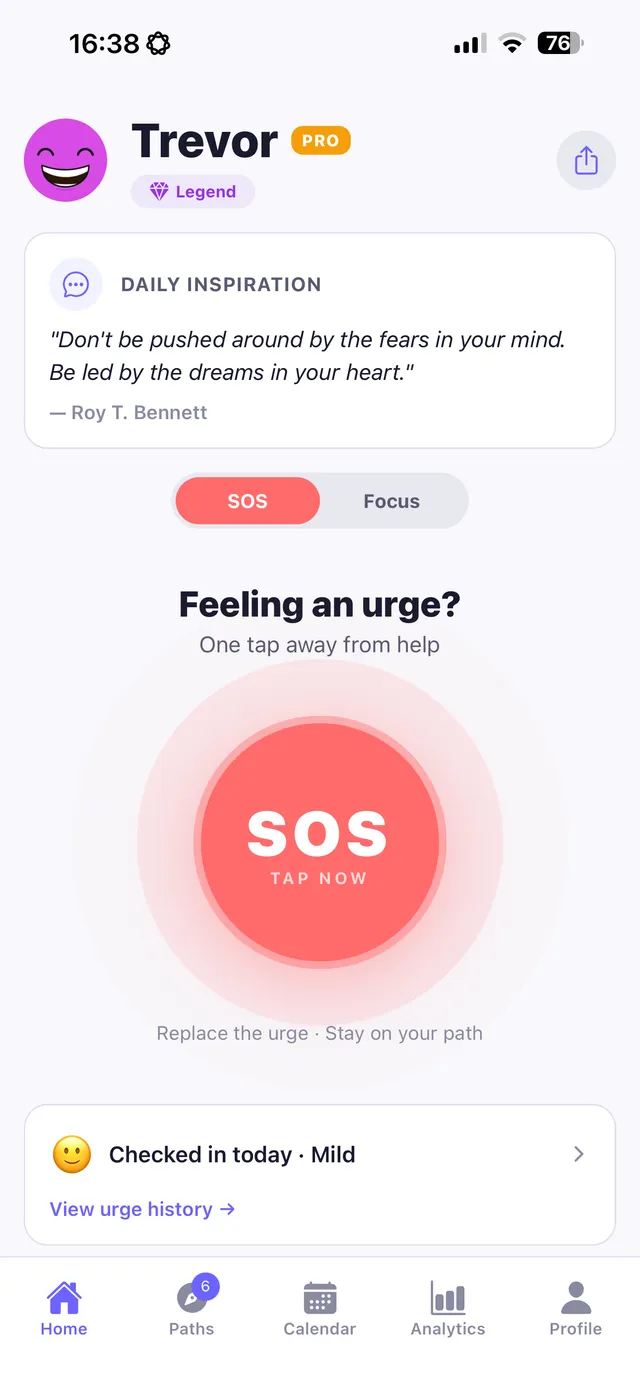
Replacify helps you swap a bad habit for a better one — with structured paths, an SOS button for cravings, a focus timer, and streaks that keep you going.


Why this matters for quitting a habit
If you're trying to quit something that runs on variable rewards — checking your phone, gambling, certain video games — understand that willpower is fighting a mechanism specifically evolved and, in many products, specifically engineered to be hard to resist. That's not a reason to give up; it's a reason to change your environment rather than relying on resisting the pull moment to moment. Removing access, adding friction, and replacing the behavior with something that has its own reward structure — like replacement behaviors — tend to work far better than trying to out-willpower a variable reward schedule directly.
The bottom line
Unpredictable rewards are more psychologically compelling than predictable ones — that's why checking, scrolling, and refreshing feel so hard to stop, and it's not a personal weakness, it's how the mechanism is built to work. Recognizing that a habit runs on variable rewards changes the strategy: reduce exposure to the unpredictable trigger rather than trying to resist it in the moment, every time.
Replacify works with this instead of against it. Choose your struggle, pick a replacement path with its own clear, satisfying reward, and when the old unpredictable pull hits, use the SOS button for an immediate alternative. Your streak gives you a steady, predictable form of progress to anchor to — the opposite of the uncertainty that made the old habit so sticky in the first place.
Frequently asked questions
What is variable reinforcement?
Variable (or intermittent) reinforcement means a reward arrives unpredictably rather than every time a behavior is performed. Research in behavioral psychology consistently shows this produces stronger, more persistent behavior than predictable rewards.
Why is checking my phone so addictive?
Notifications and social feeds typically deliver rewards — messages, likes, interesting content — unpredictably. That uncertainty keeps you checking far more than a guaranteed reward would, since each check carries a small chance of a payoff.
Can I use variable rewards to build good habits?
It's harder to engineer deliberately for yourself, so it's usually more practical to pair a new habit with small, predictable rewards early on, then let occasional bonus rewards layer on top once the habit is established.
Does turning off notifications actually help?
Yes — removing notifications reduces the intermittent 'maybe something's there' cue that keeps pulling your attention back, which weakens the variable reward loop that keeps phone checking so persistent.
Replace the habit. Not yourself.
Replacify helps you swap a bad habit for a better one — with structured paths, an SOS button for cravings, a focus timer, and streaks that keep you going.