How CBT Techniques Can Help You Break a Bad Habit

"I always fail at this." "I have no self-control." "One slip means I've ruined it." If any of those thoughts sound familiar, you've experienced one of the biggest hidden obstacles to habit change: not the habit itself, but the thinking that surrounds it. Cognitive behavioral therapy (CBT) is built around exactly this connection, and while it's best known as a treatment for anxiety and depression, its core techniques translate directly to breaking habits.
This article explains general CBT concepts for educational purposes. It isn't a substitute for professional therapy — if a habit is tied to significant distress, a licensed therapist can apply these techniques properly and address what's underneath them.
The short answer
CBT is built on the idea that thoughts, feelings, and behaviors are all connected — a thought triggers a feeling, which drives a behavior, which reinforces the thought. For habits, this shows up constantly: the thought "I always fail at this" produces discouragement, which makes giving up after a slip feel justified, which then "proves" the original thought right. CBT techniques — thought records, behavioral experiments, and identifying cognitive distortions — target this loop directly, working on the thinking pattern as much as the behavior itself.
The thoughts-feelings-behaviors triangle
CBT's central model is that these three elements constantly feed each other:
- Thought: "I've already messed up today, might as well not bother."
- Feeling: discouragement, shame, resignation.
- Behavior: giving up on the rest of the day's plan entirely.
The behavior then reinforces the original thought — "see, I really can't stick with anything" — and the loop repeats. CBT doesn't try to fix the behavior in isolation; it targets the thought that's driving the feeling that's driving the behavior. This is a useful complement to more mechanical habit-change ideas like the habit loop, which explains cue-routine-reward but doesn't address the internal narrative running alongside it.
Cognitive distortions common in habit struggles
Cognitive distortions are patterns of thinking that are inaccurate or unhelpfully extreme, and a few show up constantly around habit change:
| Distortion | What it sounds like | What's actually true |
|---|---|---|
| All-or-nothing thinking | "I broke my streak, the whole thing is ruined" | One slip is one data point, not a verdict on the whole effort |
| Overgeneralization | "I always fail at this" | Past attempts inform, but don't determine, this attempt |
| Fortune telling | "I'll never be able to stick with this" | You're predicting an outcome you don't actually know |
| Labeling | "I'm just a lazy person" | You did a specific behavior in a specific context — that's not a fixed trait |
Recognizing these in the moment is itself a skill CBT trains directly, and it connects closely to what to do after you break your streak — the practical advice there (don't treat one slip as a verdict) is essentially cognitive-distortion correction applied to habits specifically.
Replacify helps you swap a bad habit for a better one — with structured paths, an SOS button for cravings, a focus timer, and streaks that keep you going.


Concrete CBT-inspired techniques
Thought records. When you notice a strong negative reaction to a slip or craving, write down the triggering situation, the automatic thought, the feeling it produced, and then a more balanced alternative thought. This slows down the automatic thoughts-feelings-behaviors loop enough to interrupt it. You don't need a clinician to do a basic version of this — a notebook or journaling practice works fine for everyday use.
Behavioral experiments. Instead of assuming a belief is true ("I can't handle a craving without giving in"), treat it as a hypothesis and test it. Deliberately notice what happens the next time a craving hits and you use a planned replacement response instead of giving in. The actual result — often "I handled that better than I expected" — becomes evidence that updates the belief, which is more persuasive than simply telling yourself to think positively.
Identifying distortions in real time. Over time, people get faster at catching distortions as they happen rather than only in hindsight — noticing "this is all-or-nothing thinking" in the moment, rather than only recognizing it after a bad day has already unfolded.
Why this matters more than it seems
It's tempting to treat the thinking around a habit as secondary to the behavior itself — just noise around the real problem. CBT's core finding, replicated across decades of clinical use for a wide range of concerns, is closer to the opposite: the thinking often is a major part of what keeps a struggle going, because it shapes how you respond to every single slip, craving, and setback along the way. Two people can have the exact same slip and end up in completely different places afterward, purely based on the thought that followed it.
The bottom line
CBT treats thoughts, feelings, and behaviors as a connected loop, and applies directly to habit change — the thinking around a slip or craving often determines what happens next more than the craving itself does. Thought records, behavioral experiments, and simply learning to spot distortions like all-or-nothing thinking give you tools to interrupt that loop, not just the behavioral one.
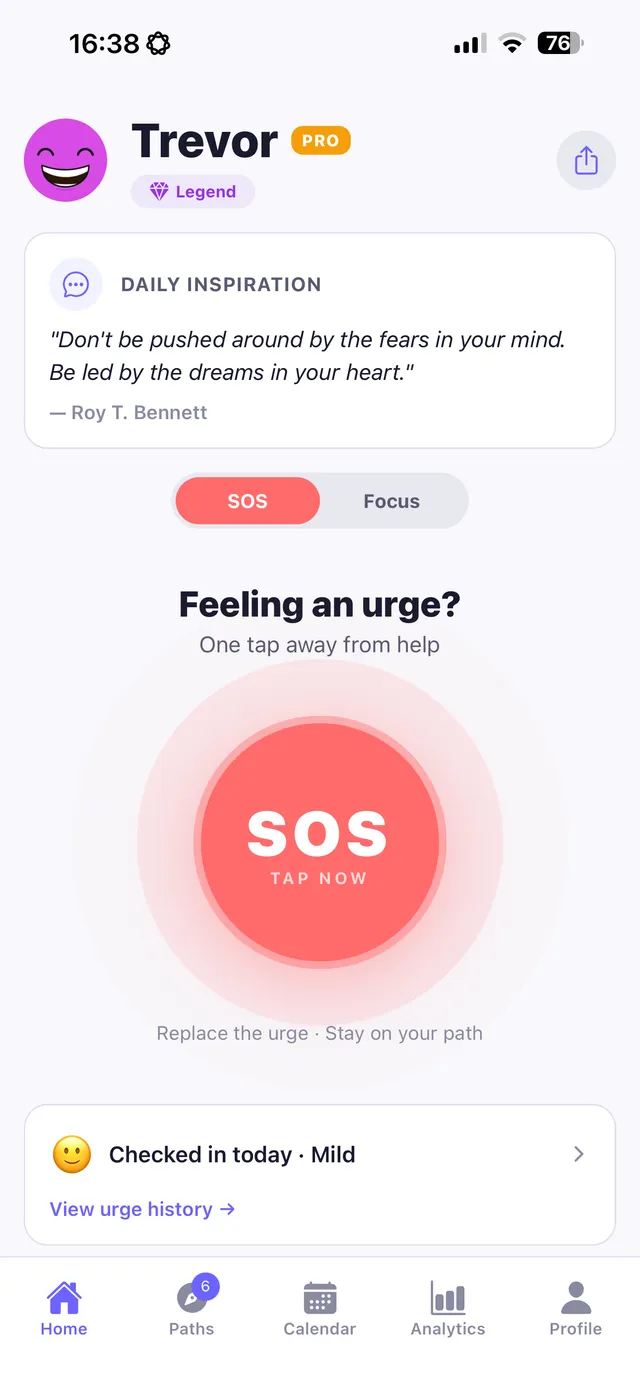
Replacify is built with this loop in mind. Choose your struggle and a replacement path, use the SOS button when a craving or a discouraging thought hits so you have a planned response instead of an automatic negative one, and let your streak serve as ongoing evidence against distortions like "I always fail at this."
Frequently asked questions
What is CBT and how does it apply to habits?
Cognitive behavioral therapy (CBT) is built on the idea that thoughts, feelings, and behaviors constantly influence each other. Applied to habits, it means the thinking around a slip or craving — not just the craving itself — often determines whether the habit continues.
What are cognitive distortions in the context of habits?
Common ones include all-or-nothing thinking ('one slip ruins everything'), overgeneralization ('I always fail'), fortune telling ('I'll never stick with this'), and labeling ('I'm just lazy'). These patterns tend to make setbacks feel more final than they actually are.
What is a thought record?
A thought record is a simple written exercise where you note a triggering situation, the automatic thought it produced, the feeling that followed, and a more balanced alternative thought — used to slow down and interrupt unhelpful thought patterns.
Is this a substitute for therapy?
No. This article explains general CBT concepts for educational purposes. If a habit is tied to significant distress, a licensed therapist can apply these techniques properly and address underlying causes this article doesn't cover.
Replace the habit. Not yourself.
Replacify helps you swap a bad habit for a better one — with structured paths, an SOS button for cravings, a focus timer, and streaks that keep you going.