Self-Efficacy: Why Believing You Can Change Is Half the Battle

Two people set the same goal — quit a habit, start exercising, build a new routine — with the same plan and the same circumstances. One believes, deep down, that they can actually pull it off. The other believes, deep down, that they probably won't. That single difference in belief is one of the strongest predictors psychologists have found for whether a behavior change attempt succeeds. It's called self-efficacy, and it's worth understanding on its own terms, separate from generic "confidence."
The short answer
Self-efficacy is your belief in your own ability to succeed at a specific task or behavior — not general self-confidence, but a task-specific expectation about your own competence. The concept is closely associated with psychologist Albert Bandura, whose work is widely referenced in this area of psychology. High self-efficacy for a specific habit predicts that you're more likely to attempt it, put in sustained effort, and recover from setbacks instead of quitting. It's built primarily through direct experience — especially small, real successes — more than through pep talks, encouragement, or information.
Self-efficacy isn't the same as confidence
This distinction matters more than it sounds. General confidence is broad and diffuse — "I'm a capable person." Self-efficacy is narrow and specific — "I can stick to a 10-minute walk after dinner." You can be a highly confident, accomplished person in your career and still have very low self-efficacy about, say, cutting back on a specific habit, because you've never built direct evidence in that particular domain. This is why general pep talks ("you've got this!") tend to do so little for habit change — they target broad confidence, not the specific, task-level belief that actually predicts follow-through.
Why self-efficacy predicts habit success
Self-efficacy shapes behavior change in a few concrete ways:
- Whether you attempt the change at all. Low self-efficacy often means not trying, or trying half-heartedly, because the outcome already feels predetermined.
- How much effort you invest. Higher self-efficacy tends to mean pushing through early difficulty rather than treating it as proof the plan won't work.
- How you respond to a setback. This might be the biggest one. High self-efficacy tends to treat a slip as one data point in an ongoing effort; low self-efficacy tends to treat a slip as confirmation of an already-expected failure. That difference alone often determines whether someone continues after breaking their streak or gives up entirely.
This connects closely to ideas from cognitive behavioral therapy — the thought "I can't do this" is both a symptom of low self-efficacy and a driver of the behavior that keeps it low, a loop worth interrupting deliberately rather than waiting for confidence to appear on its own.
Replacify helps you swap a bad habit for a better one — with structured paths, an SOS button for cravings, a focus timer, and streaks that keep you going.


How self-efficacy actually gets built
Bandura's work outlines a few sources of self-efficacy, and they're worth knowing because they point directly at what to actually do:
| Source | What it means practically |
|---|---|
| Mastery experiences | Direct personal success — by far the strongest source. Small wins matter here more than big ones you might not achieve. |
| Vicarious experience | Watching someone similar to you succeed at the same thing — part of why accountability partners and shared struggles can help |
| Verbal persuasion | Encouragement from others — real, but comparatively weak on its own without direct experience behind it |
| Physiological/emotional state | How calm or anxious you feel when facing the task — managing stress around the attempt itself matters |
The clear practical implication is that mastery experiences — actual small wins — do more for self-efficacy than almost anything else. This is a strong argument for starting smaller than feels necessary: a two-minute version of a habit that you can reliably complete builds more real self-efficacy than an ambitious version you attempt once and abandon. This is the same logic behind the two-minute rule and why identity-based habits work so well — each completed instance is direct evidence, not just an intention.
Building self-efficacy on purpose
If self-efficacy is built mainly through direct success, the practical strategy follows naturally: design your habit attempt so early wins are close to guaranteed. That might mean a smaller version of the habit, a lower daily bar, or breaking a big goal into pieces small enough that follow-through is nearly certain. Each completed instance becomes real evidence for "I can do this," which then makes the next, slightly harder version of the habit easier to attempt — a compounding cycle in the right direction, rather than the discouraging one that low self-efficacy produces.
The bottom line
Self-efficacy — your specific belief in your own ability to succeed at a particular behavior — is one of the strongest known predictors of whether a habit change actually sticks, and it's built mainly through direct, small successes rather than encouragement or information alone. Starting smaller than feels necessary isn't a compromise; it's the most reliable way to build the exact belief that harder changes later depend on.
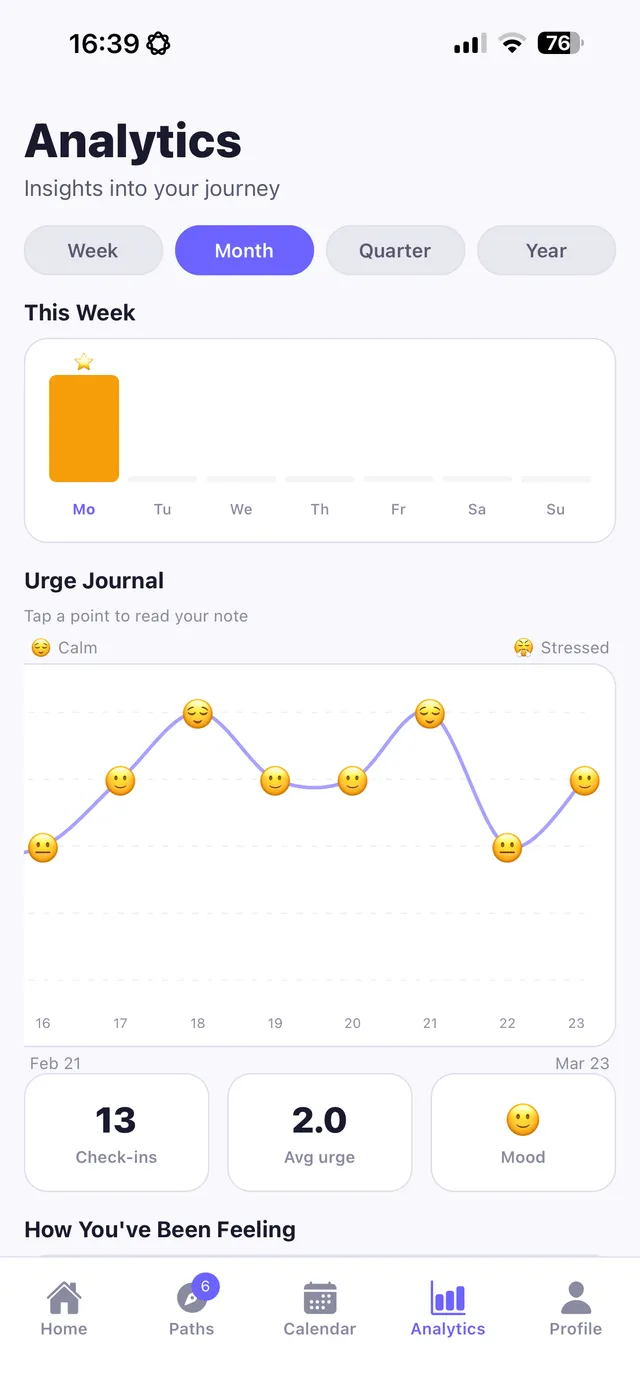
Replacify is designed to generate that evidence deliberately. Choose a struggle and a replacement path sized so early wins are realistic, use the SOS button to turn a craving into a completed win instead of a slip, and let your streak stand as concrete, accumulating proof of the belief that fuels everything after it.
Frequently asked questions
What is self-efficacy?
Self-efficacy is your belief in your own ability to succeed at a specific task or behavior. The concept is closely associated with psychologist Albert Bandura and is distinct from general self-confidence — it's task-specific rather than broad.
How is self-efficacy different from confidence?
General confidence is broad ('I'm a capable person'), while self-efficacy is narrow and specific to a particular task ('I can stick to a daily walk'). You can have high general confidence and still have low self-efficacy in a specific habit domain.
How do you build self-efficacy?
Mainly through mastery experiences — direct, small personal successes. Watching similar others succeed, encouragement from others, and managing your emotional state around the task also contribute, but direct success is the strongest source.
Why does self-efficacy matter for breaking a bad habit?
It predicts whether you attempt a change, how much effort you sustain, and crucially, how you respond to a slip — higher self-efficacy tends to treat a setback as one data point rather than proof the whole effort has failed.
Replace the habit. Not yourself.
Replacify helps you swap a bad habit for a better one — with structured paths, an SOS button for cravings, a focus timer, and streaks that keep you going.