25 Habit Stacking Examples You Can Copy Today

Habit stacking is one of the most practical ideas in James Clear's Atomic Habits — and it's easiest to understand through examples, not theory. Below is the formula, then a working list of 25 real stacks organized by part of your day, so you can copy one directly instead of inventing your own from scratch.
The short answer
The habit stacking formula is: "After [CURRENT HABIT], I will [NEW HABIT]." You attach a new habit to a specific, existing one so the existing habit acts as a reliable, automatic cue — no reminder, no motivation required. Pick a current habit you never skip (brushing your teeth, making coffee, sitting down at your desk) and stack the new behavior directly after it, not "sometime in the morning."
Why the formula works
Most habits fail at the cue stage — you intend to do something but never get reliably reminded to start. Habit stacking solves this by borrowing a cue that already works: something you do every single day without fail. It's the most direct, practical application of Law 1 from the 4 Laws of Behavior Change — make it obvious. For the mechanics and psychology behind why this works, see habit stacking.
Two rules make stacks actually stick: be specific (not "in the morning" but "after I pour my coffee"), and keep the new habit small enough that it doesn't feel like a burden tacked onto something easy — the two-minute rule pairs naturally with stacking for exactly this reason.
Morning stacks
- After I turn off my alarm, I will drink a full glass of water.
- After I make my coffee, I will write down three priorities for the day.
- After I brush my teeth, I will do 10 push-ups.
- After I get dressed, I will make my bed.
- After I sit down for breakfast, I will read one page of a book.
Work stacks
- After I open my laptop, I will write down my single most important task.
- After I sit down at my desk, I will silence my phone and put it in a drawer.
- After I finish a meeting, I will write one line of notes before moving on.
- After I close my laptop for lunch, I will stand up and stretch for two minutes.
- After I send my last email of the day, I will write tomorrow's to-do list.
Evening stacks
- After I get home, I will change out of my work clothes immediately.
- After dinner, I will wash my plate right away instead of leaving it.
- After I clear the dinner table, I will take a 10-minute walk.
- After I plug in my phone to charge (outside the bedroom), I will read for 10 minutes.
- After I brush my teeth at night, I will write one line in a journal.
Health and movement stacks
- After I finish a work call, I will do a 2-minute stretch.
- After I pour my morning coffee, I will take my vitamins.
- After I sit down on the couch, I will do 5 minutes of mobility work first.
- After I use the bathroom, I will drink a sip of water.
- After I walk in the door from the gym, I will lay out tomorrow's gym clothes.
Phone and screen-time stacks
- After I unlock my phone, I will check my to-do list before any app.
- After I feel the urge to check social media, I will take three slow breaths first.
- After I finish a scrolling session, I will put my phone in another room.
- After I sit down to watch TV, I will put my phone on the opposite side of the room.
- After I feel bored and reach for my phone, I will open Replacify's SOS button instead.
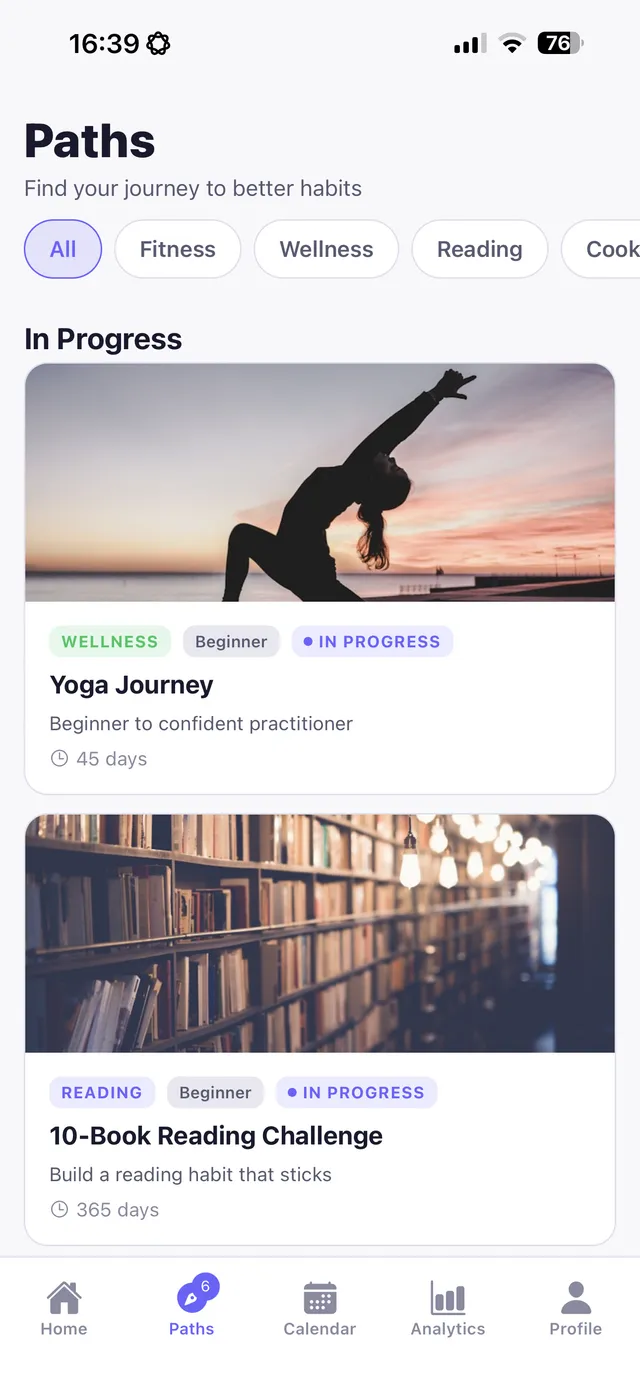
Replacify helps you swap a bad habit for a better one — with structured paths, an SOS button for cravings, a focus timer, and streaks that keep you going.


How to build your own
Pick a current habit that's genuinely automatic — you do it every day without needing a reminder. Then choose a new habit small enough to complete in under two minutes at first. Write the full sentence out: "After [X], I will [Y]." Vague plans ("I'll meditate more") don't survive a busy day; specific stacks tied to an existing cue usually do.
If you're trying to break a habit rather than build one, the same logic works in reverse — stack a replacement action onto the cue that currently triggers the bad habit. Our replacement behaviors list has more ideas for what to swap in.
The bottom line
Habit stacking works because it removes the hardest part of habit-building — remembering to start — by borrowing a cue you already act on automatically. Pick one stack from this list, write the specific sentence, and try it for a week before adding another. Replacify takes the same principle further: choose a struggle and a replacement path built around this kind of stacking, use the free SOS button when a craving hits instead of your old habit, and track the streak that builds from each stack you keep.
Frequently asked questions
What is the habit stacking formula?
'After [CURRENT HABIT], I will [NEW HABIT].' You attach a new habit to an existing, automatic one so the existing habit acts as the cue for the new behavior.
What makes a good habit stack?
Specificity and small size. Choose a current habit you never skip, and keep the new habit small enough — ideally under two minutes — that it doesn't feel like a burden.
Can habit stacking help break a bad habit, not just build one?
Yes. You can stack a replacement action onto the cue that currently triggers the bad habit, so the replacement fires automatically instead of the old response.
How many habit stacks should I start with?
Start with one or two. Adding too many stacks at once usually causes all of them to fail; build consistency with a couple before layering on more.
Replace the habit. Not yourself.
Replacify helps you swap a bad habit for a better one — with structured paths, an SOS button for cravings, a focus timer, and streaks that keep you going.