The Behavioral Psychology of Habits: Why We Repeat What We Repeat
Why does checking your phone feel automatic, while starting a workout feels like a decision every single time? Behavioral psychology has a straightforward answer: it's not about which habit is "better," it's about how much reinforcement each one has received. Understanding that mechanism is more useful than any amount of willpower advice.
The short answer
Behavioral psychology explains habits through reinforcement: a behavior followed by a reward gets repeated, and a behavior repeated enough times, in response to a consistent cue, becomes automatic — performed with less and less conscious thought. This is why bad habits often feel effortless (they've been heavily reinforced over years) and good habits often feel effortful (they haven't been reinforced enough yet). The fix isn't more willpower — it's more consistent reinforcement of the behavior you actually want.
Reinforcement: the engine of habit formation
At the center of behaviorism is a simple principle: behavior that is rewarded tends to be repeated, and behavior that isn't tends to fade. This applies whether the reward is obvious (a snack tastes good) or subtle (relief from boredom, a brief dopamine hit from a notification). Every time a behavior is followed by something that feels good — or removes something that feels bad — the connection between the situation and the behavior gets a little stronger.
This is also why bad habits can be so persistent: they're often reinforced immediately (the relief or pleasure is instant), while the reinforcement for good habits is frequently delayed (you don't feel fitter after one workout). Immediate reinforcement wins more often than delayed reinforcement, which is one of the core asymmetries behind why it's so hard to quit something that gives you a quick reward.
Cues: what triggers the behavior at all
A habit doesn't happen in a vacuum — it's triggered by a cue: a time of day, a location, an emotional state, a preceding action. Over enough repetitions, the brain links the cue to the behavior so tightly that the cue alone can trigger a craving before you've consciously decided anything. This is the basis of the habit loop — cue, craving, response, reward — that shows up across almost all popular writing on habits, including James Clear's 4 Laws of Behavior Change.
Practically, this means the fastest way to change a habit isn't to fight the response in the moment — it's to change what cue you're exposed to, or what you do right after it fires. That's the whole logic behind having a specific replacement ready, like the ones in our replacement behaviors list.
Automaticity: why repeated behavior stops feeling like a decision
The more a behavior gets repeated in response to the same cue, the less conscious thought it requires — a process psychologists call automaticity. Early on, a new habit takes real mental effort: you have to remember to do it, decide to do it, and push through resistance each time. With enough repetition, that same behavior can run almost on autopilot, triggered by the cue with barely any deliberation at all.
This cuts both ways. It's why a bad habit you've had for years can feel involuntary — the behavior has become so automatic it barely registers as a choice. It's also the good news: a new habit that feels effortful today can become genuinely automatic with enough consistent repetition. It's not that some people have more willpower — it's that their habit has simply been reinforced and repeated more times. See how long it takes to build a habit for what that repetition actually looks like in practice.
Replacify helps you swap a bad habit for a better one — with structured paths, an SOS button for cravings, a focus timer, and streaks that keep you going.


What this means for changing your own habits
Three practical implications fall directly out of the behaviorist model:
- Reinforce immediately. If you want a new habit to stick, give yourself some form of immediate positive feedback — even something as small as checking off a streak — because delayed rewards compete poorly against instant ones.
- Interrupt the cue, not just the response. Trying to resist in the exact moment a craving fires is the hardest possible point to intervene. Changing your exposure to the cue, or having a pre-decided replacement, is more reliable.
- Expect early repetitions to feel effortful. Automaticity is a product of repetition, not motivation. Feeling like a new habit "isn't natural yet" after a week is expected, not a sign it's not working.
The bottom line
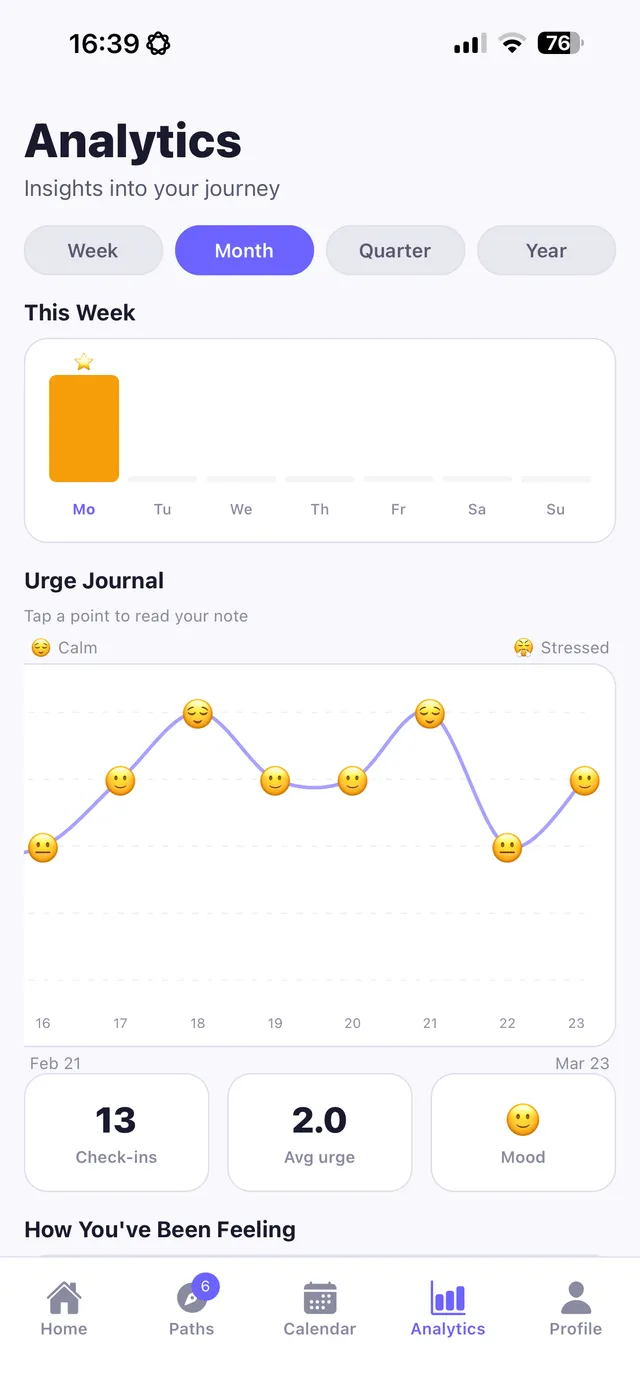
Habits aren't a test of character — they're a product of reinforcement, cues and repetition, exactly as behavioral psychology describes. The behaviors that feel automatic today became that way through consistent reinforcement, and the same process can build new ones. Replacify is designed around this mechanism directly: choose a struggle and a replacement path, use the free SOS button to interrupt the cue the moment an urge hits, and track your streak so each repetition gets its own immediate, visible reinforcement.
Frequently asked questions
What does behavioral psychology say about how habits form?
Behaviors that are reinforced (rewarded) tend to be repeated, and behaviors repeated enough times in response to a consistent cue become automatic, requiring less conscious effort over time.
Why do bad habits feel harder to break than good habits feel to build?
Bad habits are often reinforced immediately (instant pleasure or relief), while good habits are often reinforced only after a delay. Immediate reinforcement tends to be more powerful, which makes bad habits feel stickier.
What is automaticity?
Automaticity is the process by which a repeated behavior requires less and less conscious thought over time, eventually running with minimal deliberation once the cue appears.
How can I use behavioral psychology to change a habit?
Give yourself immediate reinforcement for the new behavior, change your exposure to the cue that triggers the old one, and expect early repetitions to feel effortful — automaticity builds with repetition, not motivation.
Replace the habit. Not yourself.
Replacify helps you swap a bad habit for a better one — with structured paths, an SOS button for cravings, a focus timer, and streaks that keep you going.