How to Focus Better: 12 Evidence-Based Ways to Improve Concentration

You sit down to work and within minutes you've checked your phone, opened three tabs and wondered what's for lunch. If you're trying to figure out how to focus better, you're not alone — modern life is almost perfectly designed to fragment attention. The good news: focus isn't a fixed trait. It's something you can protect, and something you can train.
The short answer
To focus better: remove distractions (phone out of reach, notifications off), do one task at a time, work in timed sessions with breaks, clarify the next step, sleep enough, move regularly, and practise sustained attention — reading, deep work, meditation. Small environmental changes often help more than trying harder.
Why focusing is so hard
- Constant interruptions from notifications, messages and email.
- Task switching, which has a cognitive cost each time you switch back.
- Unclear tasks that make your brain look for something easier.
- Tiredness, stress and poor sleep.
- Habitual checking, trained by thousands of phone pickups. How to stop checking your phone.
12 ways to focus better
| Strategy | Why it helps |
|---|---|
| 1. Phone out of reach | Removes the biggest distraction |
| 2. Notifications off | Fewer interruptions |
| 3. Single-task | Avoids switching costs |
| 4. Timed sessions | Makes effort finite |
| 5. Clear next step | Reduces avoidance |
| 6. Plan your hardest task first | Uses peak energy |
| 7. Take real breaks | Restores attention |
| 8. Sleep 7+ hours | Concentration depends on it |
| 9. Move your body | Improves alertness and mood |
| 10. Drink water, eat regularly | Avoids energy dips |
| 11. Train attention | Reading, meditation, deep work |
| 12. Close the loops | Write down worries and to-dos |
1–2. Remove distractions
Research has suggested that even having your smartphone visible on the desk may affect performance on attention-heavy tasks for some people. The simplest fix: put it in another room during focused work, and turn off non-essential notifications.
3. Single-task
Multitasking usually means rapid switching, which slows you down and increases mistakes. Choose one task and close everything unrelated to it.
4. Use timed sessions
Work in focused blocks — 25 minutes is the classic Pomodoro length — followed by short breaks. The Pomodoro Technique.
5. Clarify the next step
Vague tasks invite distraction. Replace "work on the project" with "draft the three bullet points for section two". How to stop procrastinating.
6. Do your hardest task at your peak
Many people focus best earlier in the day; others later. Schedule demanding work for your best hours.
Replacify helps you swap a bad habit for a better one — with structured paths, an SOS button for cravings, a focus timer, and streaks that keep you going.


7. Take real breaks
Short breaks away from screens — a walk, stretching, looking out of a window — help maintain focus over a day. Scrolling during breaks often isn't restful.
8. Sleep enough
Sleep deprivation reliably impairs attention and memory. Improving sleep is one of the most powerful focus upgrades there is.
9. Move
Physical activity is linked to better mood and cognitive function. Even a brisk 10-minute walk can help you reset.
10. Eat and drink regularly
Long gaps without food or water can leave you foggy and distracted.
11. Train your attention
Sustained attention improves with practice. Read books, do deep work in longer blocks, or try meditation. How to start meditating.
12. Close open loops
Unfinished tasks and worries pull at your attention. Write them down before starting focused work so your brain can let go.
When focus problems might be something more
If you struggle to concentrate in most areas of life, or problems with focus come with low mood, anxiety, sleep issues or significant impact on work or school, talk to a doctor. ADHD, depression, anxiety, sleep disorders and other conditions can affect concentration, and support is available.
The bottom line
Focus is less about willpower and more about environment and habits. Put your phone away, single-task, work in timed sessions, clarify your next step, protect your sleep, move and train your attention with deeper activities. Small changes add up quickly.
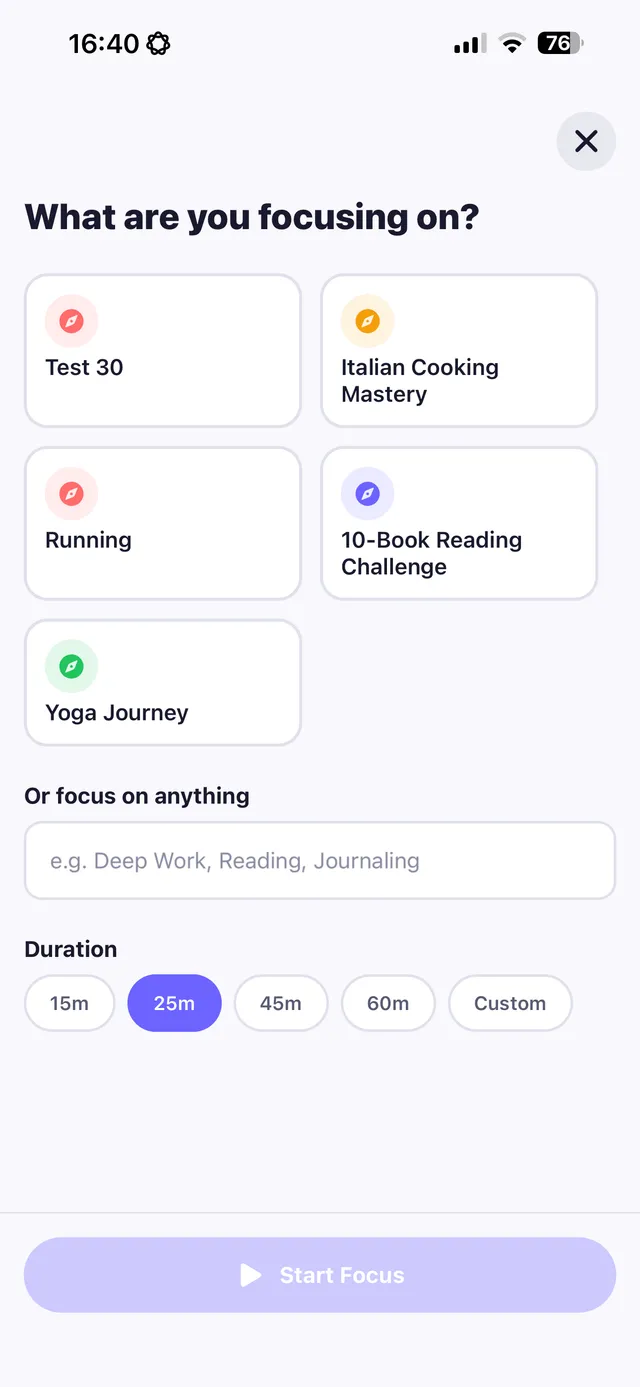
Replacify's focus timer (15, 25, 45 or 60 minutes) gives you ready-made phone-free sessions. Link them to a replacement path and they can complete steps automatically, add the Focus widget to your home screen for one-tap starts, and join focus marathon challenges to build the habit.
Frequently asked questions
How can I focus better?
Remove distractions, single-task, work in timed sessions with breaks, clarify the next step, sleep enough, move regularly and practise sustained attention through reading or meditation.
Why can't I concentrate?
Common causes include constant notifications, task switching, unclear tasks, tiredness, stress and poor sleep. Persistent problems may be linked to conditions like ADHD, depression or anxiety.
Does putting my phone away help me focus?
Yes. Keeping your phone out of sight and turning off notifications removes the most common source of interruptions and the urge to check.
Can you train your attention span?
Yes. Regular reading, deep-work sessions and meditation can make sustained attention easier over time.
Replace the habit. Not yourself.
Replacify helps you swap a bad habit for a better one — with structured paths, an SOS button for cravings, a focus timer, and streaks that keep you going.