Hitting a Plateau? Why Habit Building Stalls and How to Push Through

The first week of a new habit runs on excitement. The second week runs on the momentum of the first. And then, somewhere around week three or four, a lot of people hit a wall: the habit stops feeling new, the early motivation has evaporated, and it hasn't yet become automatic enough to run on its own. That gap — between the novelty fading and the automaticity kicking in — is the habit-building plateau, and it's the single most common place people quietly give up.
The short answer
A habit-building plateau happens because novelty wears off before automaticity has fully taken over. Early motivation is driven by the newness of the change itself, not by the habit's actual long-term reward — and that newness fades well before the habit loop has repeated enough times to feel effortless. The way through isn't more motivation; it's usually one of a few concrete adjustments: reconnecting with your underlying "why," adding a nearby reward, changing the difficulty, or bringing in outside accountability.
Why the plateau happens
Three things typically overlap right around the point people plateau:
- Novelty fades. Anything new gets a temporary motivation boost just from being new. That boost is real but it's also temporary by nature, and it runs out on a predictable timeline regardless of how meaningful the habit actually is.
- Initial motivation isn't the same as automaticity. Early on, you're doing the habit because you decided to. Automaticity — the point where the habit runs with much less conscious effort — takes longer to build than the novelty boost lasts, which creates a gap where the habit needs deliberate effort but doesn't have fresh motivation to supply it. This is the same mechanism covered in the science of habit formation.
- The reward is still too far away. Many valuable habits — fitness, saving money, learning a skill — have real payoffs, but those payoffs are slow to show up. Without a nearer-term reward, the habit loop doesn't have enough reinforcement yet to keep running on its own.
What actually pushes people through
Revisit your why, specifically. Vague motivation ("I want to be healthier") fades fast. Reconnecting with something concrete and personal — a specific reason this habit matters to you right now — tends to hold up better than a general goal. This connects to identity-based habits: "I am someone who trains" is more durable through a plateau than "I want to get fit," because it isn't dependent on visible progress to feel true.
Add a reward that isn't the final outcome. If the real payoff is months away, manufacture something closer — mark a streak milestone, use temptation bundling to pair the habit with something you enjoy, or simply track and celebrate consistency itself rather than waiting for results.
Adjust the difficulty, not the commitment. A plateau is sometimes a sign the habit is harder than it needs to be right now. Shrinking it temporarily — a 10-minute version instead of the full one — keeps the streak and the cue-behavior link alive without asking for more effort than you currently have.
Get an accountability partner. Telling someone, checking in with them, or simply not wanting to report a broken streak adds an external push exactly when internal motivation is at its weakest point. More on this in accountability partners.
Replacify helps you swap a bad habit for a better one — with structured paths, an SOS button for cravings, a focus timer, and streaks that keep you going.


Plateaus are a normal stage, not a failure signal
The instinct during a plateau is to interpret it as proof the habit "isn't working" or that you're not cut out for it. That interpretation is usually wrong — a plateau is a predictable stage almost every habit goes through, not evidence the habit has failed. Treating it as normal, expected friction rather than a verdict makes it much easier to push through instead of quitting right before the habit was about to become automatic.
This is also where a lot of people break their streak for the first time — not because of a single hard day, but because the plateau made the habit feel pointless enough to skip once, and once turned into a pattern.
The bottom line
A plateau isn't a sign your habit-building has failed — it's the predictable gap between novelty fading and automaticity taking over. Reconnecting with a specific reason the habit matters, adding a nearer-term reward, temporarily shrinking the difficulty, or bringing in an accountability partner are all concrete ways to get through that gap instead of quitting right before the habit was about to click.
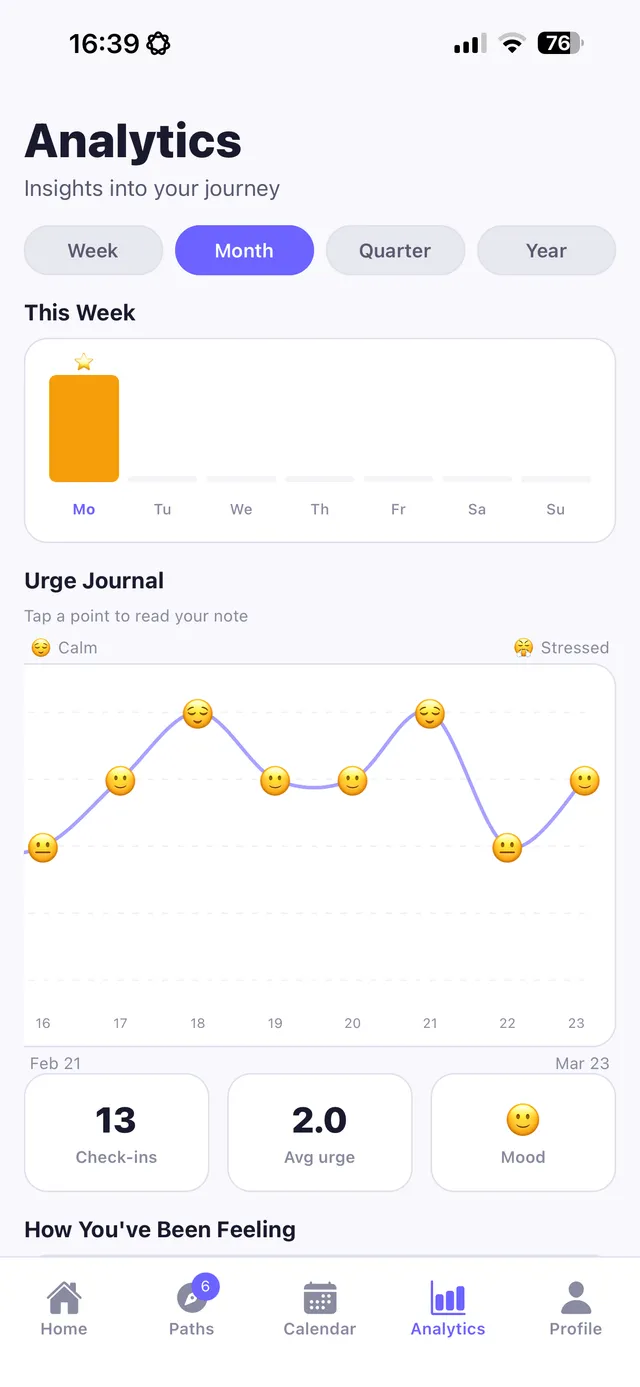
Replacify is built to help carry you through exactly this stretch. Your streak keeps the habit visible even when motivation dips, the SOS button is there for the moments a plateau makes the old habit tempting again, and choosing a specific replacement path — rather than a vague intention — gives you something concrete to keep coming back to until the new behavior stops needing willpower at all.
Frequently asked questions
Why does my new habit feel harder in week three or four than in week one?
Early motivation is driven largely by the novelty of starting something new, and that novelty fades on a predictable timeline — usually before the habit has become automatic enough to run with less conscious effort.
Is a habit plateau a sign I'm failing?
No, it's a normal and expected stage in habit building, not evidence the habit isn't working. Most people who successfully build a habit go through a plateau at some point before it becomes automatic.
How do I push through a habit-building plateau?
Reconnect with a specific, personal reason the habit matters, add a nearer-term reward instead of waiting for the final payoff, temporarily reduce the habit's difficulty, or bring in an accountability partner to add external motivation.
Should I make the habit easier during a plateau?
Often, yes. Temporarily shrinking the habit to a smaller version keeps the streak and the cue-behavior link alive without requiring more effort than you currently have, which can carry you through until motivation returns.
Replace the habit. Not yourself.
Replacify helps you swap a bad habit for a better one — with structured paths, an SOS button for cravings, a focus timer, and streaks that keep you going.